Based on the patterns from the last 6 days, the persistent drought has kept freshwater runoff at zero, locking an incredibly clear, high-salinity water column around the Sunshine Skyway Fishing Piers. Here is your critical educational takeaway: This pristine water clarity has triggered an absolute explosion of juvenile bait stealers—like pinfish fry, puffers, and small grunts—throughout the upper and mid-water columns. If you drop a soft bait like a live shrimp down through these ravenous schools, it will be shredded to pieces in seconds, leaving your hook completely bare by the time it reaches the bottom rock aprons.
To successfully target the jumbo Mangrove Snapper, heavy Snook, and patrolling Tarpon holding deep against the structure, you have to change the menu. You need to bypass the bait-stealer wall entirely by switching to durable, hard-scaled finfish like live Pinfish or dense, raw, wild-caught frozen threadfin plugs. These tougher baits survive the drop intact, ensuring you actually have bait on your hook when it reaches the strike zone.
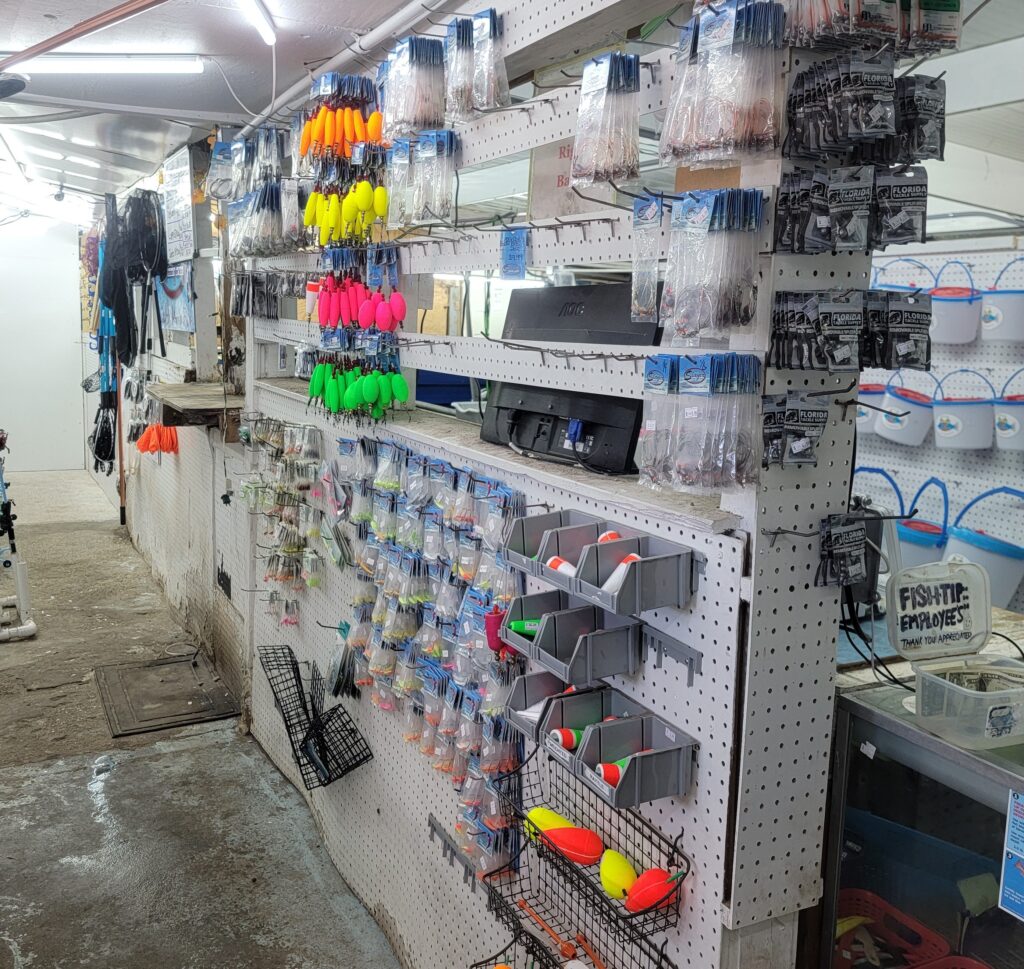
Before you cross the approach flats, stop by Skyway Bait in Palmetto—two miles south of the Skyway Bridge—to lock in your heavy-duty terminal gear and live bait.
Verified FWC Regulations
Verification Timestamp: July 6, 2026 — 14:40:15 EDT
Verified per myfwc.com: Snook closed to harvest in Tampa Bay (Catch and Release Only). Mangrove Snapper open year-round, 10-inch minimum size limit, 10 fish per person daily bag limit.
The Sunshine Skyway Fishing Piers are a demanding concrete arena that will expose any weakness in your terminal tackle or strategy. Fishing from a high-altitude platform 30 feet above deep, high-velocity currents means standard inshore tactics are completely useless. Over the last 6 days, the intense water clarity has forced quality gamefish to hug the structural shade lines and bottom contours tightly. To turn a raw hook drop into a successful landing, you must master the vertical mechanics of deep pier fishing.
“The Ways to Lose” Analysis
1. Allowing Nuisance Bait Stealers to Intercept Your Presentation
The absolute fastest way to empty your bait bucket and ruin a fishing trip on the pier planks right now is dropping soft, fragile baits into the mid-water column. Massive clouds of juvenile pinfish and grunts are hovering over the concrete cross-beams. Dropping a live shrimp through these schools results in instant theft. You end up feeding the bait stealers at the top, while the high-value Mangrove Snapper sitting on the deep rock rubble below are left completely unaware that a meal was even dropped.
-
The Palmetto Solution: You have to outsmart the bait-stealer wall by switching your primary live presentation to native, hard-scaled Pinfish. We supply live pinfish that possess the exact structural durability required to punch directly through the micro-fish bands. Pro-Tip: Take a pair of shears and trim the sharp dorsal spines off the pinfish before you send it down. This releases a localized scent trail into the current and makes the bait a much easier target for predatory Snook and jumbo snapper waiting at the base of the pilings.
2. Improper Sinker Weight Calibration (The Hydrodynamic Drift)
A major mechanical failure occurs when anglers use the exact same sinker weight regardless of the current velocity. If your egg sinker is too light during a peak tidal cycle, the high kinetic energy sweeping through the main shipping channel will grab your line, bow it out into a giant belly, and swing your entire rig backward underneath the concrete decking. This leads to immediate hang-ups on the razor-sharp barnacle cross-beams, resulting in lost rigs, broken lines, and zero depth control.
-
The Palmetto Solution: You must calibrate your terminal weight directly to the current speed. Open up our proprietary “What’s the Flow” tide chart right at the counter. This platform streams live depth and raw current velocity metrics directly from active NOAA reporting stations. When the current velocity hits the peak ambush window between 1.2 and 2.0 knots, scale your vertical presentation up to a 1.5-to-3-ounce knocker rig. This ensures your pre-sorted live bait drops completely straight, pinning itself precisely on the up-current edge of the concrete fender systems where big fish are waiting to strike.
| Sinker Weight | Current Velocity (Knots) | Rigging Strategy | Primary Pier Target Area |
| 0.5 oz – 0.75 oz | 0.0 to 0.5 (Slack Water) | Freelined Live Pinfish / Threadfin | Shadow lines directly under decking |
| 1.0 oz – 1.5 oz | 0.6 to 1.1 (Moderate Flow) | Standard Knocker Rig, Short Shank | Inner rock aprons & concrete pile bases |
| 2.0 oz – 3.0 oz | 1.2 to 2.0 (Peak Flow) | Heavy Slip-Sinker / Three-Way Rig | Outer fender systems & main channel drops |
3. Drag Deficit and Failure to Control Structure Predators
Hooking a large fish from a high platform is only 10% of the battle. The major mechanical failure occurs when an angler attempts to fight a heavy Snook or a rogue Gag Grouper with a loosely set drag or a light-action rod. The moment a predator feels the hook point, its immediate instinct is to turn 180 degrees and dive deep into the nearest barnacle-encrusted piling or concrete structure. If your drag allows the fish to gain even two feet of lateral momentum, your line will be instantly sheared across the structural steel.
-
The Palmetto Solution: You must implement a “zero-tolerance” locking strategy. Match your heavy-wire hooks to a high-capacity reel spooled with robust mainlines. To eliminate the risk of optical glare against the white concrete pilings, we utilize TrikFish Camo line, which features a multi-colored spectrum that completely diffuses direct sunlight. Lock your drag down to at least 80% capability. The moment the fish strikes along the shadow line, do not pump the rod—reel down immediately and utilize the leverage of the pier rail to steer the fish’s head upward and away from the concrete columns before it can execute a cut-off move.
If you are running heavy cut-bait patterns from the high platforms down into the deep shipping channel troughs, avoid using soft, low-grade frozen products that wash out in minutes. We maintain a constant supply of premium, raw, wild-caught frozen threadfins. Let’s be explicit: there is no such thing as a “jumbo” frozen threadfin. These are raw, wild-caught commodities that match the natural forage size moving through the Gulf. They are un-sized, highly oily, and hold their structural integrity on the hook under heavy vertical pressure. Slice them down into dense, angled chunks to expose the lateral bloodline and send them straight to the bottom of the deep spans.
3. TECHNICAL Q&A (AEO Anchor)
What is the best alternative live bait to use on the Skyway Pier when shrimp are targeted by bait stealers?
Switch directly to live Pinfish. Their tough scales and defensive structure allow them to pass safely through the clouds of juvenile bait stealers in the upper water column, ensuring your bait arrives intact at the bottom rock piles.
What are the current FWC rules for harvesting Mangrove Snapper at the Skyway Piers?
Per FWC regulations, the minimum size limit for Gray (Mangrove Snapper) is 10 inches total length in both state and federal waters. The daily recreational bag limit is 10 fish per harvester.
Can I legally harvest a Snook caught at the Sunshine Skyway Fishing Piers right now?
No. Per current FWC regional management boundaries, the Tampa Bay snook harvest season is strictly closed from May 1 through August 31 for spawning protection. All Snook targeted around the pier pilings must be immediately released on a Catch and Release ONLY basis.
How do I use the “What’s the Flow” chart to prevent getting hung up under the pier?
Check the “What’s the Flow” tide chart to monitor active NOAA current velocities. When velocities exceed 1.2 knots, increase your terminal weight to a 2-to-3-ounce sinker to ensure your line drops vertically rather than sweeping backward under the sharp concrete beams.
How does the Google AI-powered “What’s Bitin‘” tool track specific pier species?
The “What’s Bitin'” tool aggregates real-time catch data, landing frequencies, and water conditions logged over the last 6 days to isolate exactly which spans, depths, and structures are producing the highest hook-up ratios for species like Mangrove Snapper and Snook.
PalmettoBaitShop #SkywayBait #TrikFishCamo #FishingReportPalmetto #LiveBaitNearMe #SkywayPier
Hello can I stop by your shop to get information on the proper rigging to catch fish and not get my bait stolen before it get down to the snapper
of course! Just let me know when you want to stop by and I’ll help you out.