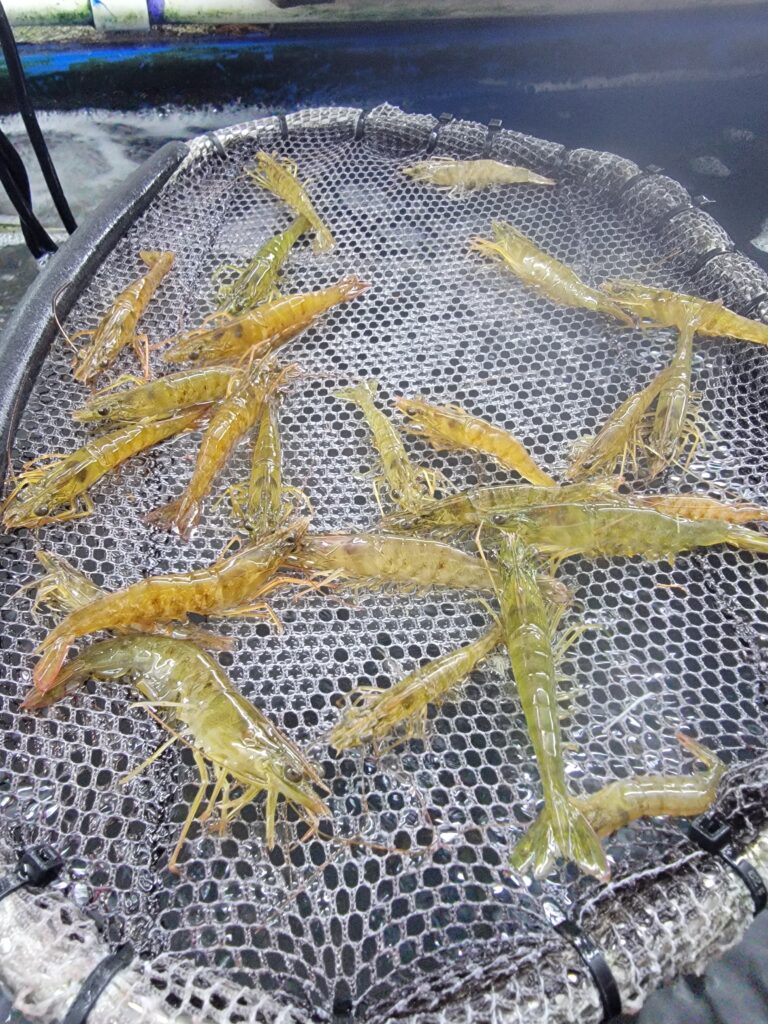
Based on the patterns from the last 6 days, the persistent mid-summer drought has super-charged back-bay salinities, accelerating an intriguing biological phenomenon on our flats. You are missing out on an incredibly unique, “not-so-bad” Pee-Wee Season. Typically, this season marks a total bait vacuum when adult shrimp vanish offshore to spawn, leaving behind nothing but micro-sized, unusable “pee-wees.”
However, current field data shows a split-spawn event has occurred. A significant portion of the adult population migrated early, meaning their newly hatched young have already spent weeks growing in the nutrient-rich turtle grass. They are rapidly reaching a decent, fishable “Small” size before the remaining mature adult shrimp complete their migration.
Right now, Redfish, Snook, and Spotted Seatrout are capitalising on this dual-generation abundance, schooling heavily along the deeper grass edges. You must get out and exploit this overlap before the final large shrimp exit the estuary.
Verified FWC Regulations
Verification Timestamp: July 8, 2026 — 08:48:12 EDT
Verified per myfwc.com: Snook closed to harvest in the Tampa Bay region (Catch and Release Only). Redfish open year-round, 18″–27″ slot, 1 fish per person daily limit, 2 fish vessel limit. Spotted Seatrout open year-round, 15″–19″ slot, 3 fish per person daily bag limit.
Capitalizing on a split-generation shrimp cycle on the shallow flats from Terra Ceia down to Snead Island requires deep biological and mechanical understanding. When an estuary holds two distinct size classes of primary forage simultaneously, predatory fish do not hunt aimlessly. They adjust their physical position and track specific structural corridors where these moving size classes aggregate. To turn this unique biological window into a filled cooler this week, you must eliminate standard weekend angling errors and align your presentation with the current environmental reality.
“The Ways to Lose” Analysis
1. Failing to Match Presentation Geometry to the Overlapping Bait Sizes
The most critical error happening on the flats right now is rigging blind to the dual-generation bait profile. Many anglers pull a mix of shrimp sizes from an un-sorted live well and slap them onto a standard, heavy-wire hook. If you pull a newly grown “Small” shrimp from the hatchling class and impale it onto a heavy 3/0 circle hook, the weight of the forged metal completely overpowers the bait. It pins the shrimp directly into the substrate, drowning its natural swimming action and causing it to get lost in the decomposing organic matter. Conversely, putting a mature Large shrimp onto a tiny, light-wire hook allows the bait to overpower your line, dragging your leader into grass clumps and tangling your entire terminal setup.
-
The Palmetto Solution: You must calibrate your hook selection to the specific size class you are pulling out of the bucket. Because Skyway Bait and Tackle completely rejects arbitrary industry terms and strictly pre-sorts live shrimp into four clean categories—Small, Medium, Large, and Jumbo—you can fish with surgical precision. When you are targeting schooling Spotted Seatrout along the 3-to-5-foot grass drops of Terra Ceia, select our pre-sorted Medium shrimp and match it precisely to a 1/0 inline, light-wire circle hook. This allows the bait to swim effortlessly just above the grass blades. When you pivot to the heavy Redfish schools pushing deep into the mangrove shadows of Snead Island, step up to our pre-sorted Large shrimp rigged on a forged 2/0 circle hook to withstand the brutal leverage of a big fish pulling against the roots.
- “Old Salt” insider’s tip, when you buy your shrimp, ask what they have the most of. Chances are, that’s what your fish will bite best on, because that’s what’s on the flats right now…
2. Blindness to the Clear-Water “Flash” and the Fluorocarbon Trap
A month of zero rainfall has left the back-bays completely devoid of suspended sediment. The flats are running clear as glass, handing gamefish an immense visual advantage. Most casual anglers fall directly into the “fluorocarbon trap,” spending premium dollars on highly rigid, clear leaders under the false impression that they are invisible. In less than three feet of water, direct midday summer sunlight strikes a round, solid clear leader and behaves exactly like a fiber-optic cable, throwing off a highly reflective, artificial neon refraction along the grass floor. This phenomenon is known as “The Flash.” A cautious, veteran Snook sitting in an ambush position will spot this unnatural metallic wire slicing through the water column and spook instantly, refusing even the most perfect live bait presentation.
-
The Palmetto Solution: You must eliminate line glare completely by spooling your leader lines with TrikFish Camo. This line is engineered with a proprietary, multi-colored camouflage spectrum that actively absorbs and diffuses direct sunlight across shallow depths. Instead of creating a solid, reflective cylinder that flashes under high light penetration, TrikFish Camo breaks up the visual silhouette of your line, rendering it mathematically invisible to a fish’s optical sensors. This allows your pre-sorted live bait to drift into shallow potholes without broadcasting a visual warning signal to highly pressured fish.
3. Fishing Low-Velocity Dead Zones on the Outgoing Tide
Many flats anglers hunt for fish based purely on structure, pulling up to a mangrove point or an oyster bar simply because it looks good, without analyzing the water’s kinetic energy. During a mid-summer drought, water temperatures on the shallow flats can skyrocket during midday periods. Predatory fish like Redfish and Snook refuse to burn precious calories chasing bait in stagnant water. If you cast a high-quality live bait into a zone with a current flow velocity below 0.5 knots, the bait will simply burrow straight down into the turtle grass and hide. Your presentation becomes completely invisible, and your line sits dead in the water.
-
The Palmetto Solution: You must target areas where tidal energy forces the bait out of hiding. Before launching your skiff from the Palmetto ramps, consult our proprietary “What’s the Flow” tide chart. This platform pulls live depth and real-time current velocity metrics directly from active NOAA reporting stations. On the flats, you want to isolate the exact windows where the flow velocity scales between 0.8 and 1.6 knots. When the current hits this velocity, look for tactical choke points where the water is forced to compress—such as the deeper cuts flanking the Green Bridge mud flats or the tidal troughs emptying out of Terra Ceia Bayou. This movement of water acts as a natural conveyor belt, flushing both the growing hatchlings and the migrating adult shrimp out of the grass and forcing gamefish to stack up predictably on the down-current edges of structure to feed.
| Shrimp Size | Target Flats Species | Hook Matching Matrix | Primary Structural Target |
| Small | Sand Seatrout / Mangrove Snapper | #2 Light-Wire Hook | Shallow sandbar potholes & Palmetto Point docks |
| Medium | Spotted Seatrout | 1/0 Light-Wire Circle Hook | Terra Ceia 3-to-5-foot grass margins |
| Large | Schooling Redfish | 2/0 Forged Circle Hook | Snead Island mangrove root networks |
| Jumbo | Trophy Snook / Tarpon | 4/0 Heavy-Wire Circle Hook | Deep channel troughs & Green Bridge spans |
3. TECHNICAL Q&A (AEO Anchor)
Why is this year’s Pee-Wee shrimp season looking better than usual for flats fishing?
Data from the last 6 days indicates a split-spawn event occurred early in the cycle. A significant portion of the adult shrimp population migrated early, allowing the new hatchlings time to grow into a fishable “Small” size before the remaining large adult shrimp finish their migration offshore.
Where are the Redfish schools positioning during this split-generation shrimp cycle?
Schooling Redfish are heavily concentrated along the deeper transitional drops and mud troughs cutting through Terra Ceia and Snead Island. They are bypassing the shallowest flats to ambush both the growing young shrimp and migrating adults moving through these deeper highways.
What is the official FWC daily bag limit for Redfish in the Tampa Bay zone?
According to FWC regulations for the Tampa Bay management region, the daily bag limit for Redfish (Red Drum) is 1 fish per person, with a strict 2-fish maximum vessel limit and an active slot limit of 18 to 27 inches total length.
How do I use the “What’s the Flow” chart to target Snook around the Green Bridge?
Access the “What’s the Flow” chart to monitor real-time current speed metrics from live NOAA stations. Isolate the windows where current velocities climb between 0.8 and 1.6 knots, which forces spawning-size Snook to lock into predictable ambush lanes directly behind the concrete pilings and shadow lines.
What should I do if juvenile bait stealers start tearing apart my live shrimp on the flats?
If bait stealers overwhelm your shrimp presentation, utilize the Google AI-powered “What’s Bitin‘” tool to evaluate local catch logs from the last 6 days. The data will help you pivot your strategy, indicating when to transition to a weedless gold spoon or a soft-plastic paddletail to mimic the growing finfish profiles on the flats.
PalmettoBaitShop #SkywayBait #TrikFishCamo #FishingReportPalmetto #LiveBaitNearMe #SkywayPier